Jazu pulls a large leaf from a tree, makes a roll-up with it and then drops into a beach hammock. He’s spent the past hour kite-surfing the waves, managing a few jumps and spins.
‘You’re good at this,’ I say as he lights up.
‘Nah, the wind’s not strong enough today; can’t do many tricks out there.’
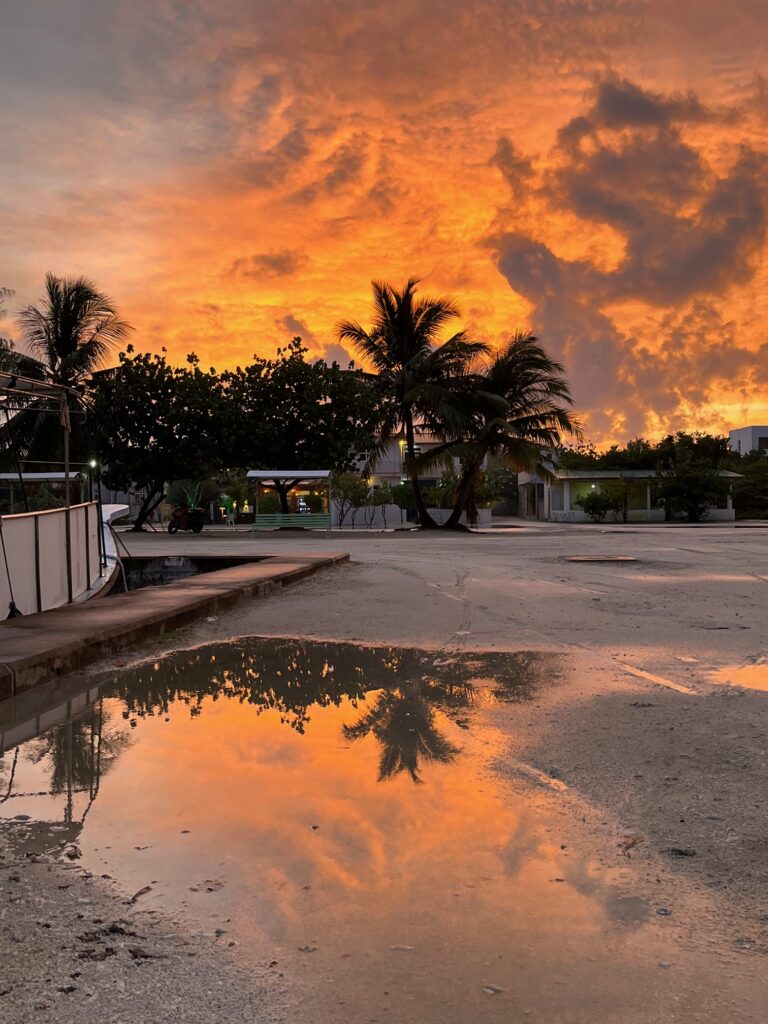
Jazu takes a puff and leans back. There was a storm last night and the wind is still up, which means fewer trips out today. So it’s kite-surfing instead. Tomorrow it could be a dive with whale sharks or big game fishing, depending on how the winds blow.
Welcome to life in the Maldives, where folk like Jazu help visitors experience all these islands have to offer. And they have a ridiculous amount to offer.
In our two weeks we saw a humpback whale, swam with sharks and turtles, fed stingrays, and snorkelled around a shipwreck. Then there are the seas themselves, a stunning mix of layered turquoise, azure, cobalt and, well, blue.
Although our visit was during low season (July/August), the seas were calm and, apart from a solitary storm, the weather was impeccable. The Maldives’ reputation for being expensive has some merit, but you are in the middle of an ocean where nearly everything is imported. With a bit of planning, it’s possible to experience these jaw-droppingly amazing experiences and still keep on the good side of your bank manager.
So here’s our guide to visiting the Maldives.
Getting to the Maldives
Flights arrive at Velana International Airport (MLE), in the capital Malé.
From Male, you’ll need a ferry to reach your island, of which there are 1,190. Put them all together and you have less than 300 km2, making it Asia’s smallest country.
Velana Airport has a few options: public ferry will take about double the time of other boats but is a fraction of the cost. Shared speedboats are regularly available or there are private, more pricey options. If you’re heading farther out, there’s also a seaplane counter. Speedboats and ferries are literally yards away from the arrivals’ area and the main resorts have their own counters. Public ferries don’t run to private resort islands.
You may need to wait a couple of hours, in which case there are two food courts, and little else. One is a short walk north and offers expensive KFC and pizza options. The other is near the departure lounge and has Dairy Queen, Thai Express, Coffee Club and Burger King (the latter comes with a serving of free wifi). When you’re leaving, the departures’ area is more plush and has the usual duty-free items.
Getting connected
The Maldives has two mobile phone operators for tourists to choose from: Dhiraagu and Ooredoo (for the latter, look for the adverts at the airport starring David Beckham and Neymar). Both offer the same deal (US$40/20GB or US$50/100GB). Most restaurants and hotels have free wifi.
How to pay in the Maldives
Most places accept credit cards (some with a 3% fee) but smaller shops will prefer local money or US$. If you pay with US$ the change may come in rufiyaa (Rf).
Getting around the Maldives
Before arriving, it’s worth working out your transport as it can be a costly business. Your hotel will arrange connections to local islands. The local ferry is by far the best deal but is more prone to cancellations and delays. You also can’t book it in advance; just turn up and grab a seat.
Once on an island, you can usually stroll from one side of an island in a couple of minutes so there’s no public transport.
Where to stay in the Maldives
There are two main choices. The first is to go for the resorts, who have a whole island to themselves. These five-star, over-the-water spots are exclusive with no public ferry access (so you’ll need a private speedboat, which adds to the costs). Rooms tend to be US$1000 a night or more, but during the low season there will be better deals. Some also don’t allow children to stay there. If you’re curious, or just want some cool Insta photos, day trips are possible and run from US$110. Several artificial islands are also popping up, mostly close to Mane thereby reducing ferry travel time.
Your second option is to book a hotel on another island. Since 2012, locals can run these so there’s been huge growth in this part of the tourist industry.
Top 5 Tips for the Maldives
1)
It’s not party central, so be prepared.
The Maldives may be 99% ocean but it’s a dry country, with alcohol banned from the inhabited islands. There are plenty of non-alcoholic beers like Holsten or Heineken or, if you need something stronger, private resorts have their own licences and have some fantastic bars. A few islands also have their own floating bars.
2) Different islands offer different vibes.
We stayed on two islands: Dhiffushi and Maafushi. If you’re after an isolated spot with a local feel, Dhiffushi is the answer. During our week there we probably tried every restaurant (some twice). You’ll get to know the locals well (Oppo from Dhiffushi Dive and Recreation and his talking parrot are worth chatting to) and some excursions run to nearby reefs. It’s a 200-metre walk to one side of the island to the other, so you’re unlikely to get lost.
Maafushi, on the other hand, is the closest thing to a party island. The beaches are not outstanding (by Maldivian standards) but it’s a great jumping-off point for various one-day excursions. Once the boats come back in the later afternoon, there’s usually live music, traditional dancing or locals dancing to their reggae-infused tunes.
The resorts are where the Maldives got its reputation for exclusivity and they’re still there, complete with butler-service and 24-hour everything.
3) The Maldives is no longer for the elite, but it is pricey.
Fancy a bottle of water for US$13? This is the place to be, at least if you head for the five-star resorts. Other islands offer far more budget-friendly options; three-star guesthouses are easy to find for $US100 or more, depending on the time of year (during Nov-Jan prices can triple and islands will get fully-booked). Meals for a family of four will be US$30-60. And bottled water in the non-posh spots is more like US$2.
4) Choose your days out carefully.
You’ve come to the Maldives to see the sea, and there are myriad ways to explore it.
Islands offer various trips out to nearby reefs, each teeming with an unbelievable number of natural wonders.
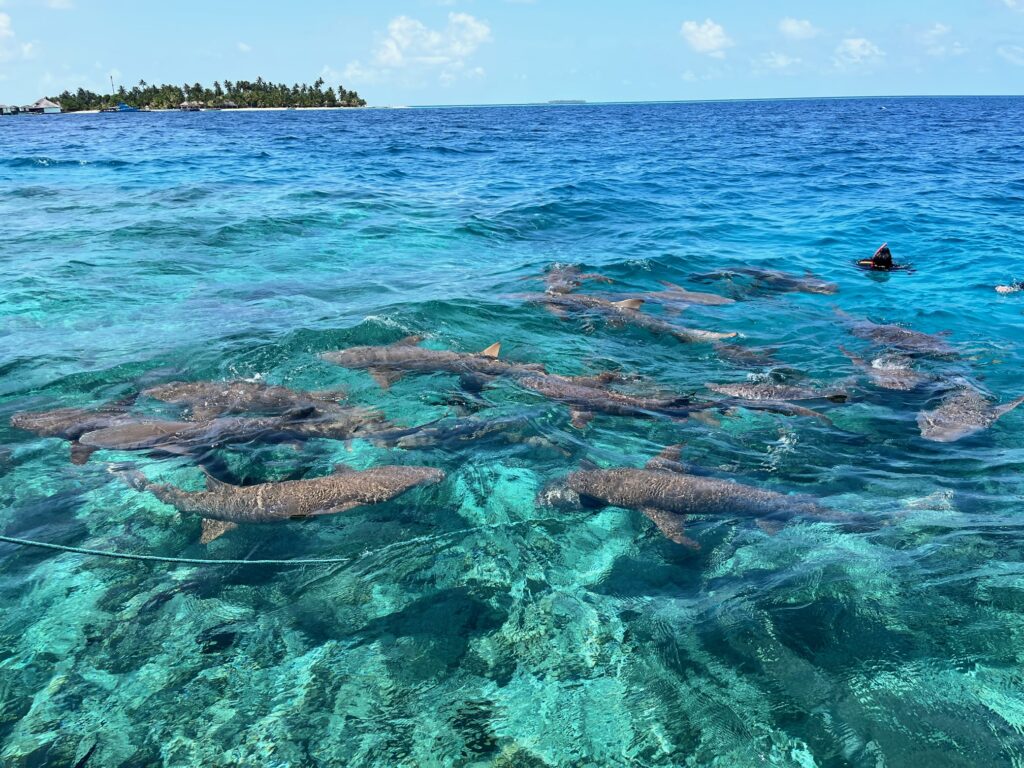
Take our first trip. We headed to Vaavu atoll where we started by feeding rays on the beach, swam with nurse sharks, spotted a lone turtle who let us swim with it for 10 minutes, dived down to a shipwreck and had lunch on an impossibly-beautiful sandbank. All for US$75 per person. The Keyodhoo wreck is one of the most popular, largely as it sits on a shallow spot in a lagoon with part of its mast still above the surface. It’s an Instagrammer’s dream. A nearby resort added a bicycle a few metres down that divers can pose by. Around 2012, a Sri Lankan captain is said to have fallen asleep, resulting in the ship going down. Locals moved it closer to the lagoon to make it accessible and since then coral, and fish, have made it home.
There are shorter trips out (US$35) to Kuda Giri and Bond Reef (with a good chance of seeing dolphins along the way) and trips to local five-star resorts (US$110-US$140 per person).
Headlining all of these is the search for the elusive whale shark (US$100). A two-hour ride is followed by lingering looks over the ocean for signs of the world’s biggest fish. If you’re lucky, you may also get to snorkel with manta rays.
Children are charged half-price for nearly all excursions. Guides also have their own GoPros and you can get their images once each trip is over.
If you do stay on your island, nature simply comes to you. Giant bats with a metre-wide wingspan swoop between coconut trees, baby black-tip sharks patrol the shores and rays will sometimes appear after dark and glide past, easily visible in the transparent waters.
Our best impromptu moment, though, came while our speedboat was heading to another reef. A humpback whale decided to swim alongside, raising its gnarly, tubercle-covered head out of the water to get a better look at us. Orcas, tiger sharks and pilot whales are relatively common visitors, but this was the first time any of the guides had seen a humpback, so their cries of surprise and delight drowned out our own.
5) It’s a family-friendly, international, kind of place. But also conservative.
Any foreigner can receive a tourist visa for the Maldives. There’s a simple form to complete, known as an Imuga, before arriving and leaving and then you’re in. Indian, Russian and UK tourists make up the majority of visitors, with a good number also coming from China, the Middle East and the US.
Once you’re here, Maldivians are incredibly welcoming, speak English well and are keen to help. We didn’t come across even a whiff of a scam or hassle. It’s also a great place for families as crime rates are low, beaches are safe and there are heaps of activities for children.
The republic is 100% Muslim, hence the lack of alcohol, dogs and pork. Designated beaches are ok for bikinis; others are not.
Maldives Fact File
The Maldives is the world’s flattest country. Its highest-point is a mere 2.3 metres above sea level.
Wonder why the Maldives’ sands are so white? It’s because they are made up from coraline.
Unsurprisingly for an island nation, seafood is eaten for breakfast, lunch and dinner. Be sure to check out garudhiya, a fresh-tasting combo of fish, rice, chilli, onions and rice.: often considered the national dish of the Maldives.
The Maldives is the smallest country in Asia.
Of the 1,190 islands, only 200 are inhabited.
The capital Male is where the country gets its name from.
Friday and Saturday are regarded as weekends here.