Meeting the world’s only living goddess requires some luck.
The Kumari, as she’s known, lives high in a temple, shielded from modern-day life. There, with a guardian, she remains alone, only occasionally getting to glimpse the bustle of the city beyond her cloistered walls.
It sounds like a fairytale but this is 21st century Kathmandu. Behind the sacred doors of Kumari Ghar, a dark-walled
Newari temple with intricate wood carvings, lives the Kumari. Every day, at precisely 11am, she appears before a crowd of worshippers.
We wait at the appointed time and a hush washes over the crowd. Tour guides make it very clear that we are prohibited from photographing the goddess and I’m asked to place my camera in my bag.
Just before 11am, a small girl pops her head above the third-storey wooden balcony. She smiles and gives me a quick eyebrow flash, which I return and she grins. There’s no way this is the goddess. True enough, it seems to be one of her few friends who is peeking her head out to see the crowd.
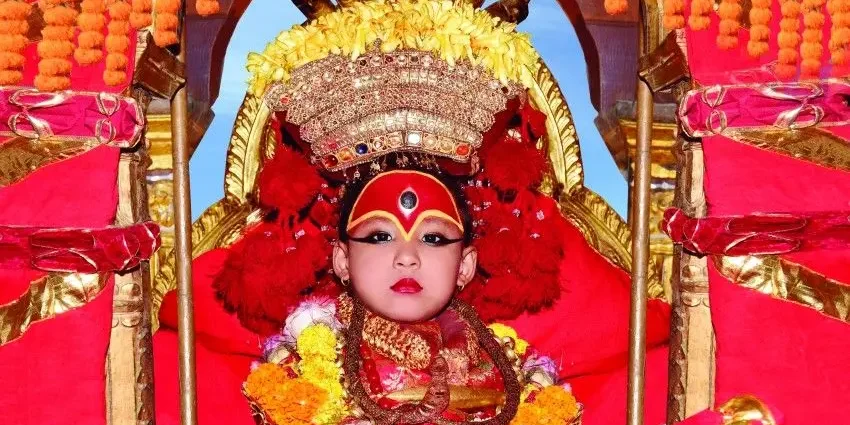
At 11am, the Kumari appears. She wears a headdress made of red tassles tied with gold bands. Red make-up with a yellow border covers her forehead, dipping down at three points, finishing just above her eyes. In the middle of her forehead is painted a third eye, placed on its side, that peers out. She looks at us impassively as the crowd gently chant blessings.
Then, after less than a minute, she silently moves back out of sight and back to her solitude. If all this sounds like Tennyson’s ‘The Lady of Shalott’, you’re not far wrong.

Kumari Ghar, home of the kumari.
How to become a living goddess
To become a Kumari is a complex process. Unusually, she is revered by both Hindu and Buddhists (a strategic move by a former king). The Kumari began in the 17th century and had close links with the Nepalese royal family. Every time the Kumari reaches puberty, a new one must be chosen. Each time, the Kumari come from the Newar community and go through a rigorous selection process, starting at two years of age.
Firstly, the child cannot have any blemishes on their skin. She is inspected to check her body proportions are appropriate and astrological charts are analysed.
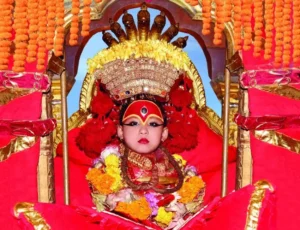
Aryatara Shakya, the Kumari. Source: Times of India
Then come the tests. The child is placed in a room where an animal is sacrificed in front of her. Priests look closely to check the child does not react, or even blink. After this, the child is taken to a dark room filled with masks and her reactions are again closely monitored.
Once a girl is chosen, her life changes forever. She will live in the temple and have a tutor every afternoon (while the family receives a lifetime pension of US$110 per month). She will learn traditional dances, rituals and be taught how to communicate using specific gestures only.
During this time, her feet must never touch the floor. The one time she is taken beyond the temple is for an annual festival, when an enormous wooden carriage is pulled by 150 men as she is taken around Durbar Square.
Life after being a kumari
Once she begins menstruation, she is no longer considered pure and so her time as a Kumari is over. She may then decide whether to go back to a normal life, where others will not be aware of her past, or continue to be known as a former Kumari.
Unsurprisingly, the life of the kumari attracts some controversy as there are concerns about the psychological impact on the girl and how she is able to readjust back into her community once her time is up.
This Kumari was appointed in September 2025. Aryatara Shakya, aged two, took over from the previous kumari, who had been in place for eight years.

Kumari Ghar, home of the kumari.