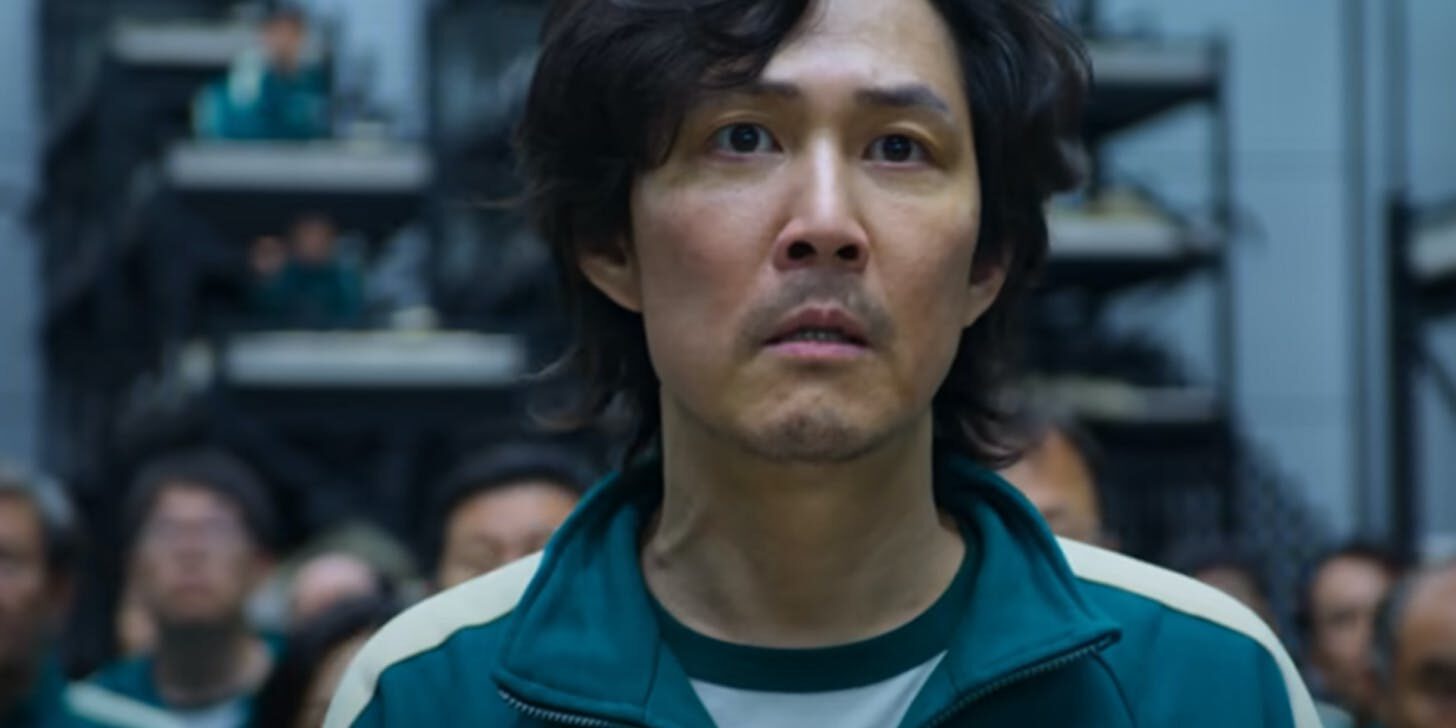
Squid Game could become Netflix’s biggest-ever original series.
So what kind of show could possibly trump Bridgerton, Money Heist or Stranger Things? It’s an unlikely contender – a Korean-made game show, played by those on the fringes of society.
The contestants play six traditional children’s games with a twist – if you lose, you die.
What starts as a gentle look at a middle-aged man mired by debt and doubts becomes very odd very quickly. After he accepts a deal to compete for 45.6 billion Korean won ($39 million), he soon realises that the stakes are high. The 456 contestants are forced to play games and, although the initial set-up seems almost comic, the ruthless and graphic nature of the violence soon changes the tone.
There isn’t much new about the ‘survival games’ genre though, so what makes Squid Game such a big deal? It’s because the show is more about the characters than the games. There’s a North Korean defector, a Pakistani worker and others who feel they have literally nothing to lose by competing in these macabre games.
What makes Squid Game special is the psychological aspects of each character. There is an element of free will involved in who competes, and the drive for possible salvation is strong than the drive for mere survival. Contestants are willing to give up everything and gamble on the chance of instant wealth. And the odds are long, as the games are wonderfully random and unforgiving. In Korea, the show has immediately become a metaphor for the country’s own economic inequalities.
While the motivation behind the big bosses who run the show remains a little flimsy and unlikely, we don’t have to spend much time worrying about that. We’re far more concerned with the inhumanity – and occasional humanity – shown by each player. Inevitably, it raises questions about how far we would go to save ourselves when there are no rules. It’s essentially Lord of the Flies for the Netflix crowd.